
Joseph Southall - Humillity
Joseph Southall - Humillity
JOSEPH SOUTHALL, RWS, NEAC, RBSA
(1861-1944)
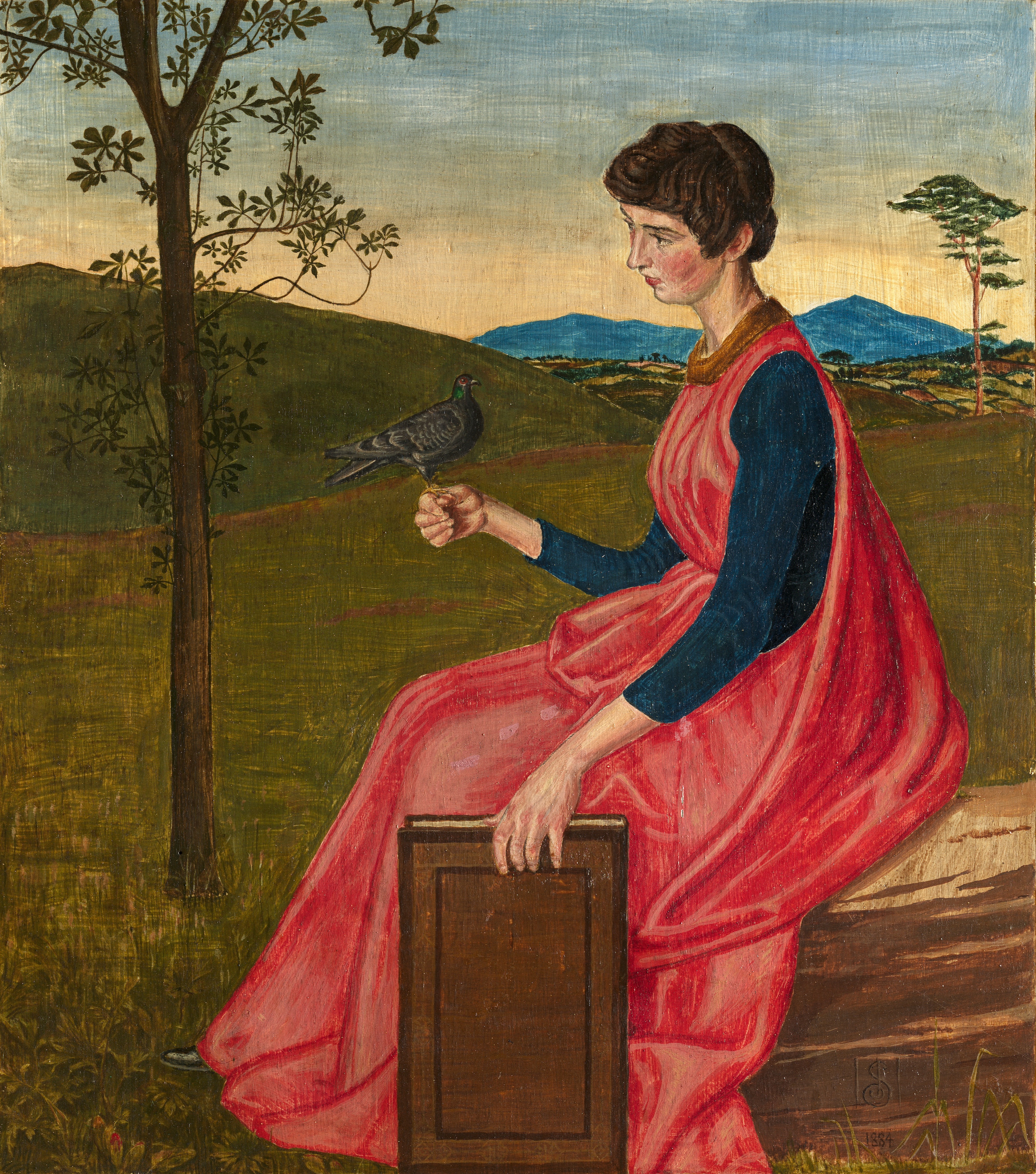
Humility
Signed with monogram and dated l.r.: JES/1884
Tempera with gold paint on panel
41.5 by 36.5 cm (16 by 14 1⁄4 ins) (frame size 54 by 49.5 cm)
Provenance: The artist’s own collection, Charlotte Road, Edgbaston until c.1947;
American Private collection.
Literature: Birmingham Museums & Art Gallery, Joseph Southall 1861-1944 Artist- Craftsman, 1980, p.45 (visible in photograph), p.89 under section (a)
This important, recently re-discovered work is perhaps the artist’s most successful attempt at tempera following his first engagement with the medium in 1883. The painting belonged to Southall for his entire life and was set within an overmantle in the artist’s drawing room in Charlotte Street, Edgbaston. The picture disappeared following Anna’s death in 1947 ending up in an American private collection. It’s subject of Humility is signified by the presence of the dove, perched on the sitter’s hand, a significant theme in Christian iconography. The landscape to the background is strongly influenced by the Italian Quattrocentro art he had encountered in Italy in the previous year. Although tempera as a medium was not unknown in Britain (and had been promoted through the work of William Blake, his follower Samuel Palmer and John Spencer Stanhope amongst others) it was yet to gain a significant foothold in British art. The present work, by one of the medium’s great and most thorough students, heralds the way for a more significant revival at the turn of the following century, of which Joseph Southall was a central part.
RELATED ITEMS





HumilitySigned with monogram and dated l.r.: JES/1884 Tempera with gold paint on panel41.5 by 36.5 cm (16 by 14 1⁄4 ins) (frame size 54 by 49.5 cm) Provenance: The artist’s own collection, Charlotte Road, Edgbaston until c.1947; American Private collection.Literature: Birmingham Museums & Art Gallery, Joseph Southall 1861-1944 Artist- Craftsman, 1980, p.45 (visible in photograph), p.89 under section (a) This important, recently re-discovered work is perhaps the artist’s most successful attempt at tempera following his first engagement with the medium in 1883. The painting belonged to Southall for his entire life and was set within an overmantle in the artist’s drawing room in Charlotte Street, Edgbaston. The picture disappeared following Anna’s death in 1947 ending up in an American private collection. It’s subject of Humility is signified by the presence of the dove, perched on the sitter’s hand, a significant theme in Christian iconography. The landscape to the background is strongly influenced by the Italian Quattrocentro art he had encountered in Italy in the previous year. Although tempera as a medium was not unknown in Britain (and had been promoted through the work of William Blake, his follower Samuel Palmer and John Spencer Stanhope amongst others) it was yet to gain a significant foothold in British art. The present work, by one of the medium’s great and most thorough students, heralds the way for a more significant revival at the turn of the following century, of which Joseph Southall was a central part. )